The Counts Pannocchieschi
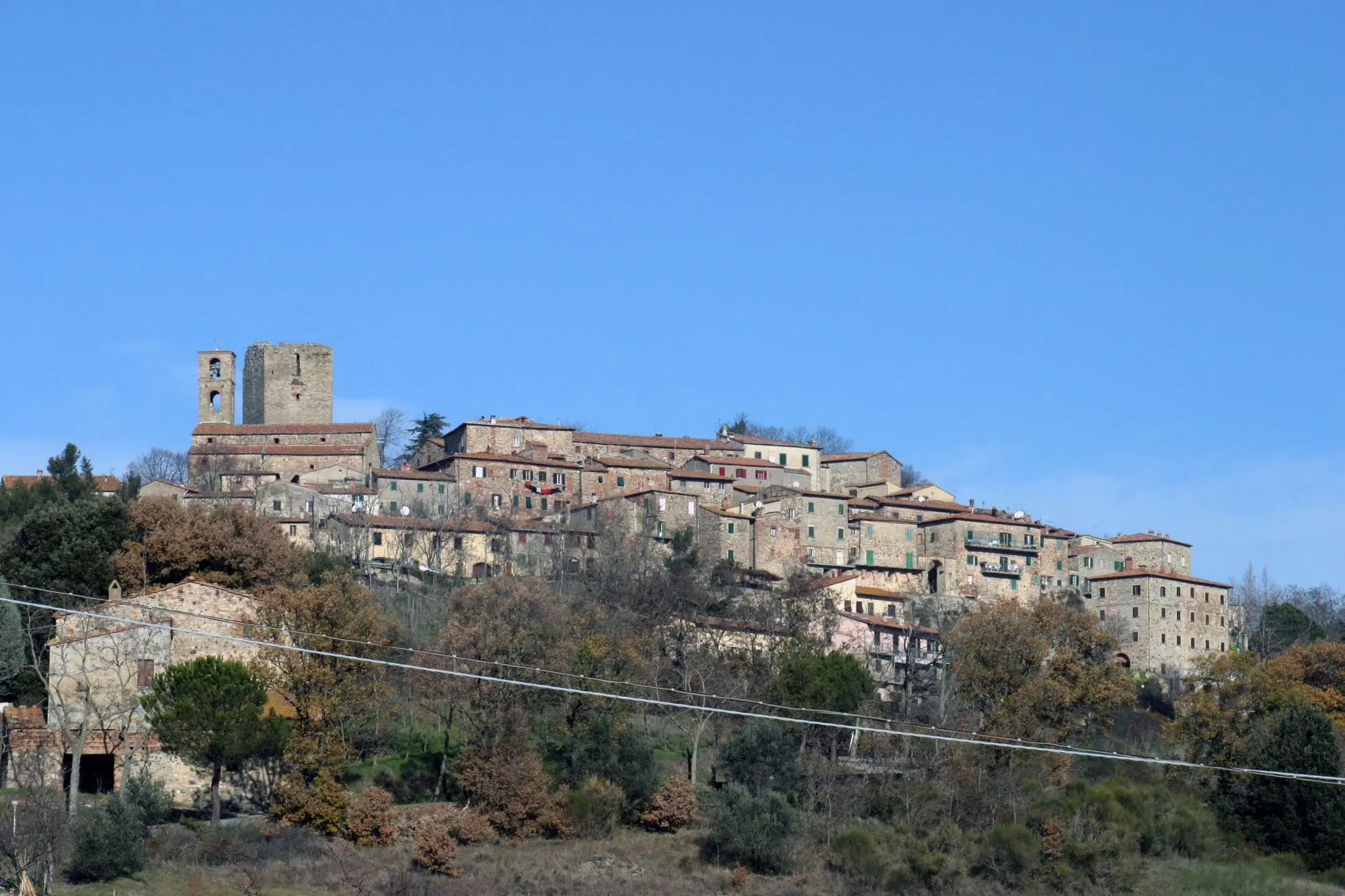
The story of the Counts Pannocchieschi is one of the most fascinating chapters of medieval Tuscany. Amid hilltop castles, mines, rivalries between city-states and feudal lordships, this family built a network of power stretching across Volterra, the Val di Cecina, the upper Val di Merse and northern Maremma.
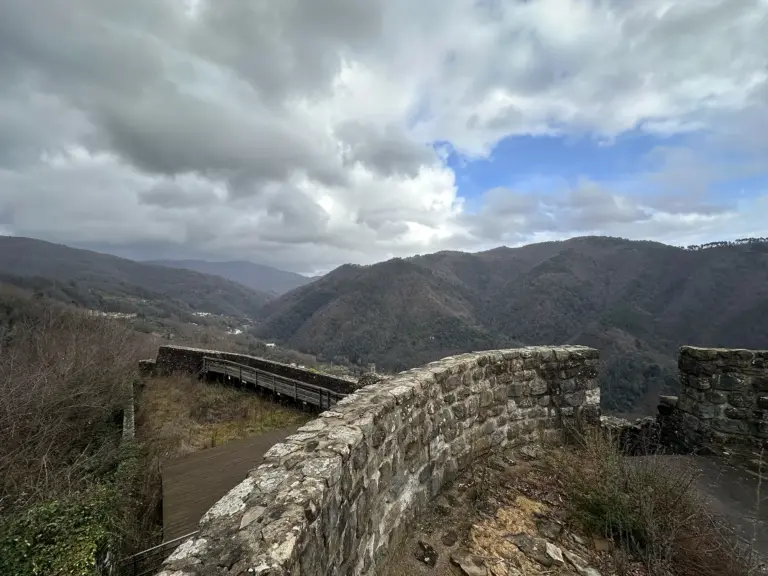
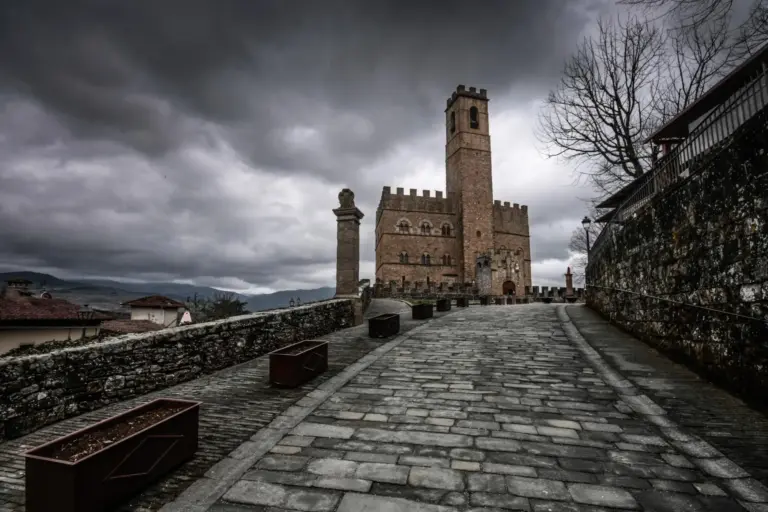
Their history is closely bound to the castles and lands over which they held rights and influence. These fortifications were not merely defensive structures: they were centres of administration, points of control over roads and routes, and hubs for managing agricultural and mineral resources.
The origins and rise of the Pannocchieschi
The earliest origins of the family are uncertain. Tradition traces it to an ancient noble lineage, sometimes thought to be of Lombard descent. The genealogy becomes more reliable from the 12th century onwards, when the Pannocchieschi emerge as one of the most influential kin groups in the territories of Volterra and Maremma.
Their rise took place in a strategic area where three major centres of power met: Volterra, with its powerful bishopric; Siena, intent on extending its influence southwards; and Massa Marittima, at the heart of a region rich in mineral resources.
Holding castles allowed the Pannocchieschi to dominate roads, villages, farmland and mining districts. The family also knew how to make use of ecclesiastical power: several of its members became bishops of Volterra, concentrating religious authority, feudal rights and political influence in the hands of a single kin group.
The Pannocchieschi bishops and the power of Volterra
Among the most important figures of the family were Galgano, Ildebrando and Pagano Pannocchieschi, key players in the political and religious affairs of the Volterra region between the 12th and 13th centuries.
Galgano Pannocchieschi, bishop from the mid-12th century, strengthened the power of the diocese and obtained significant imperial privileges. His policies met with opposition from the people of Volterra and ended with his murder in 1170.
Ildebrando Pannocchieschi, bishop from 1184 to 1211, worked to reinforce the bishop’s prerogatives. Pagano Pannocchieschi, who succeeded him in 1212, continued the struggle with the Volterran commune and neighbouring towns.
Their story shows that the Pannocchieschi were not simply a family of castle lords: they were a territorial power, able to combine ecclesiastical authority, landed property and military control.
The main castles of the Counts Pannocchieschi
Castel di Pietra: the stronghold of Nello Pannocchieschi
Among the best-known places associated with the family is Castel di Pietra, near Gavorrano in Maremma. Built on a rocky spur, the castle held a strategic position in an area important for mining and for the routes linking the inland hills to the coast.
In the 13th century it was tied to the branch of the Pannocchieschi known as “della Pietra”. Its fame rests above all on Nello Pannocchieschi and the tragic story of Pia de’ Tolomei, remembered by Dante in Canto V of the Purgatorio.
«Deh, quando tu sarai tornato al mondo / e riposato de la lunga via»
Dante Alighieri, Purgatorio, Canto V, lines 130–131
(“Pray, when you have returned into the world, / and rested from your long journey”)
Tradition, going back to the early commentators on the Divine Comedy, identifies Pia as Nello Pannocchieschi’s wife and places her death at Castel di Pietra. Both the identification and many details of the story are, however, debated, so it is important to distinguish literary memory from documented history.
Today the ruins of the castle are a significant witness to the feudal presence in medieval Maremma. Read the Castel di Pietra page on Castellitoscani.com.
Montecastelli Pisano and the Pannocchieschi Tower
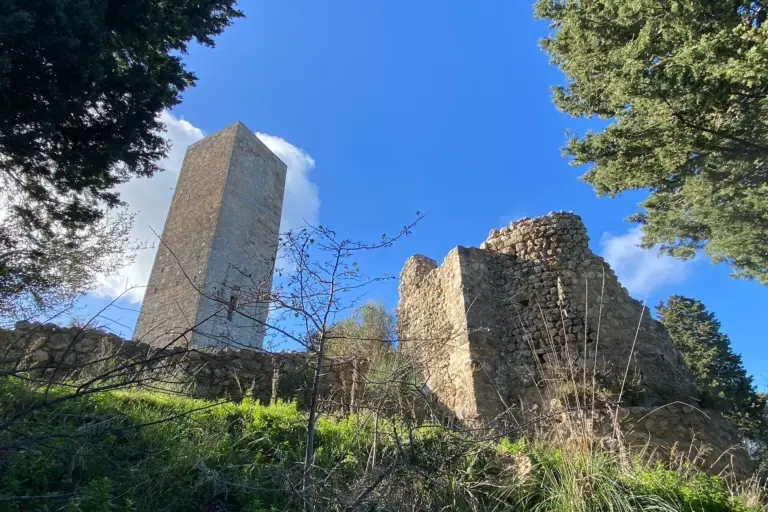
Montecastelli Pisano, in the municipality of Castelnuovo di Val di Cecina, is known for the Torre dei Pannocchieschi and for the family’s ties with the bishops of Volterra. The site shows that the family’s presence was not limited to Maremma but extended deep into the inland Val di Cecina.
The tower and village belong to a landscape in which castles, church estates and lay lordships competed for control of roads, villages and resources. Discover Montecastelli Pisano on Castellitoscani.com.
Elci Castle: the origins of the comital branch
Elci Castle, in the municipality of Radicondoli, is one of the key places for understanding the family’s history. Already recorded in the 10th century, the castle became the centre of an important feudal domain.
In 1222 Ranieri Pannocchieschi, brother of Bishop Pagano, bought the castle and took the title of Count of Elci. From this estate arose the Pannocchieschi d’Elci branch, which would preserve its prestige long after the gradual loss of feudal autonomy.
At various times the Elci domain included other castles and settlements, among them Fosini, Anqua, Montalbano and Montingegnoli. It was therefore not a single isolated estate but a structured territorial system.
Travale: the castle in the upper Val di Merse
Travale, today a hamlet of Montieri, was one of the ancient centres linked to the Pannocchieschi. Documented as early as the 12th century, it was caught up in the disputes between the family and the bishops of Volterra.
Its position was important for the routes between the upper Val di Merse and the Colline Metallifere (“Metal-bearing Hills”), an area where mineral resources were an essential part of the medieval economy.
Travale is also famous for the Travale Testimony (Testimonianza di Travale, 1158), a court record containing the vernacular phrase «guaita, guaita male, non mangiai ma’ mezo pane» (“watch, wretched watch, I never even ate half a loaf”), spoken by a castle guard: one of the earliest written examples of the Italian vernacular.
Fosini: a stronghold in the Elci castle network
Fosini Castle, in the municipality of Radicondoli, was part of the network of holdings connected to the Counts of Elci. Its history shows how the family’s power was spread across several fortified settlements, each helping to control the countryside and the routes through it.
The castle was involved in the struggles between local lords and Siena. In 1340 Count Gaddo d’Elci managed to retake Fosini from the Sienese and regained control of it. The episode illustrates how hard it was for feudal families to defend their holdings against the expansion of the city-states.
Gavorrano: controlling the mining district
Gavorrano held an important position in northern Maremma, in an area marked by mineral wealth and strategic routes. In the 13th century the town was tied to the presence and interests of the Pannocchieschi.
As happened to other settlements in the area, control gradually passed into the orbit of the more powerful city-states. The growth of Massa Marittima and Sienese expansion helped curb the autonomy of the local lordships.
Montemassi: from feudal lordship to Sienese conquest
Montemassi Castle, now in the municipality of Roccastrada, is one of the most telling places for understanding the clash between the feudal families of Maremma and the Republic of Siena.
The castle passed through several spheres of influence, including those of the Aldobrandeschi and the Pannocchieschi. In 1328 it was taken by Sienese troops led by Guidoriccio da Fogliano.
The episode is linked to the famous fresco in Siena’s Palazzo Pubblico, traditionally attributed to Simone Martini (the attribution is still debated), which shows Guidoriccio before the siege of Montemassi. The work is a visual record of Siena’s expansionist policy and of the gradual reshaping of the feudal balance in Maremma. Read the Montemassi page on Castellitoscani.com.
Rocchette Pannocchieschi: a medieval mining landscape
Rocchette Pannocchieschi, in the municipality of Massa Marittima, is another important site for reconstructing the family’s presence in the metal-rich Maremma.
The surrounding landscape preserves traces of a territory where the extraction and working of metals sustained the medieval economy. Control of mineral resources was decisive for the wealth of local lords and for the rivalries between competing political powers.
Perolla: the lords of Perolla
Perolla, in the municipality of Massa Marittima, gave its name to another branch of the family. Dividing the inheritance into several lordships allowed the Pannocchieschi to extend their presence across the region, but it also made the management of property and feudal rights more complex.
The various branches continued to share interests, make agreements and contend over the ownership of castles. In some cases a fortification was owned only in part by a single family member, which makes tracing the transfers of property particularly difficult.
Pereta and Magliano in Toscana
The presence and interests of the Pannocchieschi also intertwined with other places in Maremma, including Pereta and Magliano in Toscana. The history of these towns reflects the complexity of alliances and shifts of control among the region’s noble families.
To reconstruct each episode accurately, it is important to distinguish between direct ownership, feudal rights, alliances and temporary control. Castles could pass from one family to another, and rights over a territory did not always coincide with exclusive ownership of the fortress.
Grosseto and Maremma
Grosseto and its surroundings help frame the relationships between Maremma’s noble families, the Aldobrandeschi and the expanding city powers. The history of the Pannocchieschi belongs to a web of alliances and rivalries that involved the whole of northern Maremma.
The branches of the Pannocchieschi family
During the 13th century the family’s holdings were divided among several branches, often named after the castle or territory over which they exercised authority.
| Branch | Main castle | Area |
|---|---|---|
| Counts of Travale | Travale | Upper Val di Merse |
| Counts of Elci | Elci Castle | Radicondoli, between Val di Cecina and Val di Merse |
| Lords of Pietra | Castel di Pietra | Northern Maremma (Gavorrano) |
| Lords of Perolla | Perolla | Massa Marittima area |
| Lords of Castiglion Bernardi | Castiglion Bernardi | Monterotondo Marittimo area |
The division into branches did not mean a complete separation. Family members kept up ties of kinship, political agreements and shared property interests. Ownership of castles could be split among several co-owners, and feudal rights could change over time through sales, agreements and conflicts.
The decline of feudal power and the rise of Siena
The main threat to the autonomy of the Pannocchieschi came from the growth of the Tuscan city-states. Siena sought to extend its control southwards, while Volterra defended its prerogatives over the inland territories.
In 1263 the Pannocchieschi acknowledged Sienese supremacy. This did not mean the immediate loss of all their holdings, but it marked a turning point: the family increasingly had to deal with an ever more organised city power, capable of imposing political agreements, economic terms and military control.
The conquest of Montemassi in 1328 is one of the most emblematic episodes of this transformation. Castles that for generations had underpinned the autonomy of the feudal lordships gradually became part of territorial systems dominated by the cities.
From castles to Sienese nobility: the Pannocchieschi d’Elci
Of all the family’s branches, the Pannocchieschi d’Elci managed to preserve their prestige the longest. The name remained tied to Elci Castle and to a set of estates spread across the territories of Siena and Volterra.
Over the centuries the family became increasingly integrated into Sienese political society. In 1753 the Pannocchieschi d’Elci were admitted to the Sienese patriciate. Some members later rose to prominent ecclesiastical and diplomatic positions.
The family’s trajectory thus reflects a significant transformation: from military control of castles and countryside to membership of the urban nobility and the institutions of the early modern age.
Map of the castles linked to the Counts Pannocchieschi
The map lets you explore some of the places mentioned in this article, between Volterra, the Colline Metallifere and Maremma. Select a marker to read a short historical note and, where available, open the detailed page on Castellitoscani.com.
Locations are approximate. Ownership, feudal rights and temporary control are not necessarily the same thing.
A network of castles for understanding medieval Tuscany
The history of the Pannocchieschi traces the evolution of power in Tuscany between the 12th and 14th centuries. At first the family built its strength on castles, landholdings, feudal rights and control of mineral resources. Later it had to face the expansion of Siena and Volterra, which steadily reduced the autonomy of the local lordships.
Castel di Pietra, Montecastelli Pisano, Elci, Travale, Fosini, Montemassi and the other places linked to the family are not just ruins or medieval villages: they are the physical evidence of a political and economic system that helped shape the historic landscape of Tuscany.
It is worth remembering that not all the castles mentioned were owned exclusively and continuously by the Pannocchieschi. In some cases the family held shares of ownership or seigneurial rights, while in others control changed hands several times over the centuries. Reconstructing each individual story therefore requires comparison with archival documents and specialist historical and archaeological studies.